In the last week of July, city crews cut down three laurel oaks along South Live Oak Parkway and scheduled a fourth for the following week. From the sidewalk the trees looked healthy. City photos showed something else, and WECT reported severe decay in the major branches holding up the canopy, internal cavities as deep as two feet, and significant structural damage.
"Removing a street tree is always an absolute last resort," the city said in a statement posted to Facebook. "Unfortunately, in some situations, preservation is simply not possible without risking the safety of our community."
The city also said what would replace those trees, and that part matters more for the next half-century of Forest Hills and South Oleander. Live oaks were scheduled to go into the parkway this fall. Where overhead power lines or tight space rule out a large tree, the city said it would plant two or three smaller species in its place. On the parkway, the city picked a replacement species that lives far longer than the trees it lost.
A Tree Built for Quick Shade
To see why the July removals happened, start with the laurel oak, which NC State Extension also lists as Darlington oak. The Extension's plant toolbox says it grows rapidly to 60 feet or more and has a lifespan of about 50 years. The same entry says its short life and its growing susceptibility to disease and rot as it matures make it less desirable for home use. It also says that because it grows fast, it can give quick shade or serve as a street tree. Then it adds one line of advice: "Consider planting Q. virginiana for better longevity." Q. virginiana is the live oak.
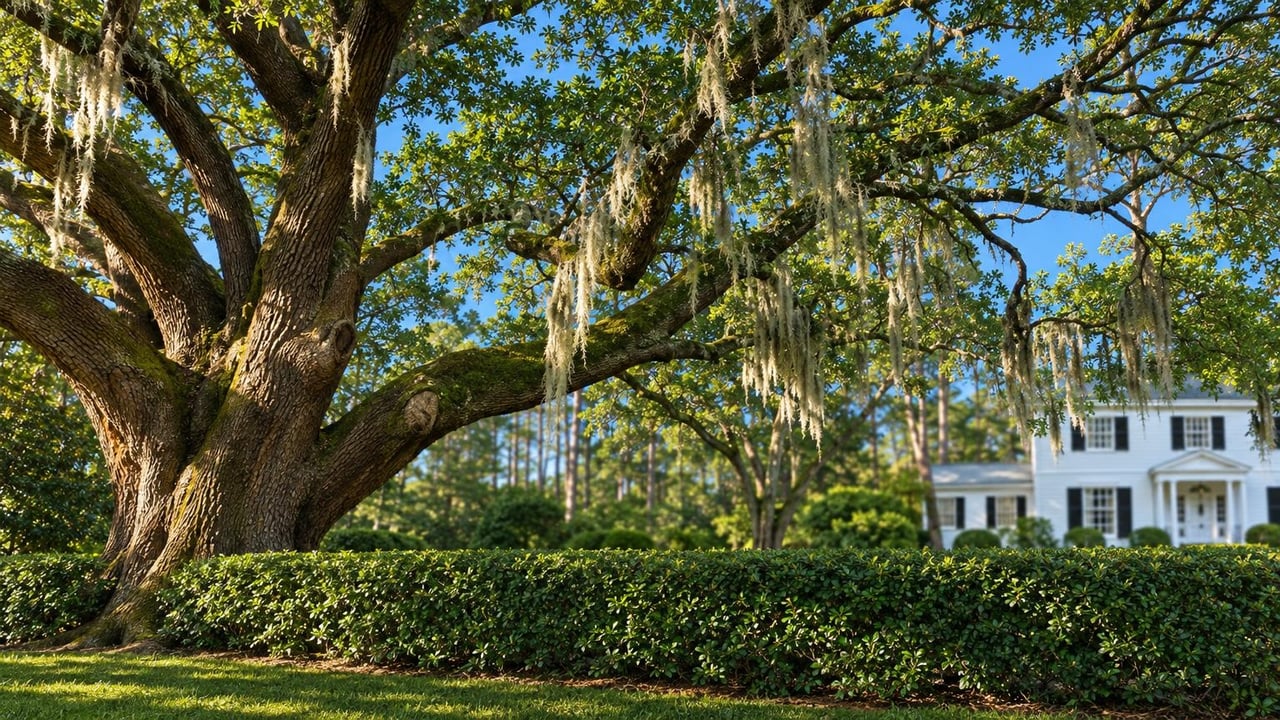
The neighborhood itself is a century old. According to a 2025 StarNews history of Forest Hills, the Irving Park Company of Greensboro began buying and developing land here in 1920 or 1921, and Wilmington realtor William A. McGirt ran the Forest Hills Development Co. locally. The first house, 314 Forest Hills Drive, drew about 1,000 people to its public open house in 1926. The same article describes the stretch of Forest Hills Drive between Colonial Drive and Wrightsville Avenue as lined with stately oaks draped in Spanish moss.
A neighborhood that has stood for 100 years can easily outlive a tree that lasts 50. At the Wilmington Tree Commission's July 22 meeting, city urban forestry staffer Aaron Reese addressed the online talk about the parkway. He confirmed that the trees being removed were laurel oaks in poor health and that there was a plan to replant. He also told the commission that staff had finished a planting plan for the fall.
The City's Answer Is the Live Oak
The swap from laurel oak to live oak is a citywide plan, and South Live Oak Parkway is one example of it. In a WHQR report from August, Landscape Superintendent Ben Misleh said laurel oaks can look healthy while hiding internal rot and are prone to dropping branches. He described the questions arborists ask before taking one down: "Is it a risk to people or property? A tree in the middle of a field, no matter how and what poor shape it's in, is not a hazard because there's nothing near it that can be hurt. So we're looking: is it next to a playground? Is it over a sidewalk where cars park?"
WHQR also reported that Misleh plans to replace laurel oaks with more live oaks, because live oaks give similar shade and are less likely to decay.
The same WHQR story explains that a new $1.5 million federal grant pays for stump grinding, which makes it possible to plant a new tree in the exact spot where the old one stood. City Council records identify the money as a North Carolina Forest Service Urban and Community Forestry Financial Assistance Program grant. The work has to happen within Inflation Reduction Act project areas that make up 36% of the city. Across the grant, WHQR reported funding to plant 300 or more trees, prune about 500, remove 100 dangerous ones and grind 200 stumps. The grant also pays to map existing trees and open planting sites by species and condition.
The planting push comes on top of a canopy that has been shrinking. In a June 2025 update to the city's Urban Forestry Master Plan, assistant Parks and Recreation director Sally Thigpen's team reported that aerial imagery showed Wilmington's tree canopy cover dropping from 48% in 2016 to 41% in 2020, as WilmingtonBiz reported. Thigpen told WHQR the grant would "catapult our program forward."
What the Crews Have Scheduled for Next Week
Removals in Wilmington's older neighborhoods continue. The city's Street Tree Maintenance page lists nine jobs for Tuesday, Dec. 1. Four of them follow the same pattern, each set for 7 a.m. to 5 p.m. with a contractor doing the work. In the 2200 blocks of Brandon Road and Carlton Avenue, a laurel oak with extensive decay throughout comes out of the right-of-way. A third decayed laurel oak comes out of the median at 414 Northern Boulevard. A dead loblolly pine in the front right-of-way of the 2900 block of Park Avenue is also scheduled.
On Park Avenue, Brandon Road and Carlton Avenue, the listed blocks will be closed to through traffic during the work, though residents can still reach their homes. On Northern Boulevard, the eastbound side of the 400 block closes and parking is not allowed while crews work. If Park Avenue is part of your route on Dec. 1, plan to go around.
Where the Older Trees Are on Record
Some of the area's trees are formally recognized. The City of Wilmington's Heritage Tree list includes a bald cypress at 406 Forest Hills Drive, designated in 2024. The list also notes the abundant live oaks along Country Club Drive from Oleander Drive to Park Avenue, a corridor just across Wrightsville Avenue from the original Forest Hills. The Wilmington Tree Commission accepts Heritage Tree nominations year-round. So the large live oak on your block can be nominated at any time.
Planting Your Part of the Next Canopy
Trees in private yards count toward the canopy too, and the season for planting them opens in January at the mall on Oleander Drive.
TreeFest, the N.C. Cooperative Extension's annual seedling giveaway, returns for its 29th year on Friday, Jan. 15 and Saturday, Jan. 16, 2027. It runs 11 a.m. to 4 p.m., or until supplies run out, in the JCPenney wing of Independence Mall at 3500 Oleander Drive. Each household can take up to five free seedlings or grass plugs, with a suggested $5 donation per household. Plants are split evenly between the two days. It is the same wing that recently got an aquarium exhibit, which we wrote about this fall.
TreeFest started for the same reason the city is replanting now. The Extension's announcement, written by Consumer Horticulture Agent Gabriella de Souza, says the event began in 1997 after Hurricanes Bertha and Fran destroyed much of the region's tree canopy. It has handed out more than 100,000 seedlings since then. At the January 2026 TreeFest, the Extension distributed 6,396 native seedlings to 759 participants across 19 species.
This year's list has more oaks than any before it: live oak, white oak, overcup oak and swamp chestnut oak. The Extension describes the live oak as a salt-tolerant, long-lived coastal classic and advises giving it plenty of room. Overcup oak handles poorly drained, seasonally wet soil, and baldcypress, the species of the Heritage Tree on Forest Hills Drive, is also on the list.
The Alliance for Cape Fear Trees has its own winter giveaways. Under the city grant, WHQR reported, the nonprofit has a $100,000, two-year contract to plant and maintain 350 street trees, and executive director Isabelle Shepherd said it is committed to giving away 1,000 native trees a year. Here is the alliance's posted schedule after Thanksgiving:
- Saturday, Dec. 19, 9 a.m. to noon: 700 native trees at D.C. Virgo Preparatory Academy, 813 Nixon Street. Downtown, Northside and Southside residents get priority from 9 to 10 a.m.
- Saturday, Jan. 23 and Sunday, Jan. 24, noon to 3 p.m.: a volunteer street-tree planting of 175 trees, done with city support.
- Saturday, Feb. 13, 2027, 9 a.m. to noon: 500 native trees at D.C. Virgo Preparatory Academy.
If the planting strip in front of your house has been empty since a removal, the same city Street Tree Maintenance page lets residents report a tree concern or request a planting.
If you're weighing how a mature oak, a recent removal or a new street planting affects a home you own or are thinking about buying in Forest Hills, our team at Thirty4 North Properties Group knows these blocks well. Contact Us and we'll walk the street with you.